
What Oldham Deed Records Show
The Oldham County Clerk is the recorder for deeds and related land instruments. A recorded deed typically names the grantor and grantee, the conveyance type, the execution and recording dates, and a legal description. It also carries a book and page or instrument number. Some filings cite the prior deed. The instrument type matters here. A correction, a quitclaim, or a commissioner's deed does not transfer the same interest as a general warranty deed.
| Deed Type | What It Does | Common Use |
|---|---|---|
| Warranty deed | Conveys the stated interest with deed covenants | Ordinary purchase or transfer |
| Quitclaim deed | Releases whatever interest the grantor may hold | Family or title cleanup |
| Correction deed | Corrects a stated defect in an earlier deed | Name or description correction |
| Commissioner's deed | Records a court-directed conveyance | Judicial sale |
| Affidavit of descent | Places heirship facts in the record | Estate research |
Mortgages, liens, easements, plats, assignments, and releases can appear in the index beside deeds without conveying the whole tract. Read the granting language. Read the legal description too. The index entry is only a pointer to the instrument itself.
Oldham Clerk Coverage Dates
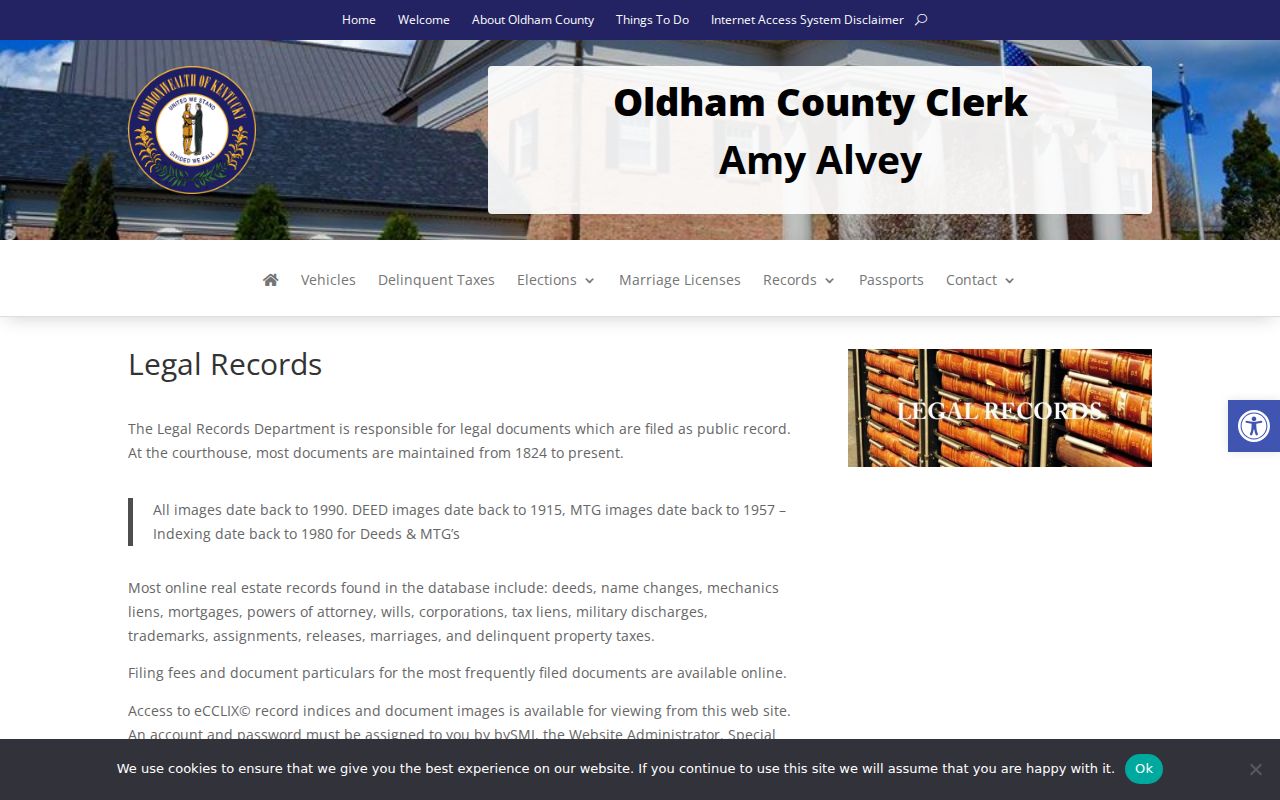
Coverage varies by document family. One cutoff date should never be applied across the board. According to the Clerk's legal-records page, the courthouse holds most documents from 1824 to the present. Deed indexing reaches back to 1980. Deed images run deeper, to 1915. Mortgage indexing also begins in 1980, while mortgage images extend to 1957. The same official page identifies access options and the Clerk offices that maintain them.
A failed online search is not the end of the road. The deed may still live in an in-office index or an archival book at the courthouse.
Oldham eCCLIX Access Paths
Online deed records run through eCCLIX access linked by the Clerk. A user name and password gate the login. Oldham residents can register for personal, noncommercial searches in Oldham County at no charge. The allowance is five searches per day. Commercial subscribers take a separate route, and the Clerk does not publish their pricing. The resident signup form asks for a name, address, contact details, and credentials. Those are registration fields, not deed search fields. Anyone can also view the public indexes and images free at the Clerk's office counter. Counter access is the key fallback. It works whenever an account gate, a coverage cutoff, or a name spelling blocks a useful result online. Note: Search access fees, copy costs, and filing charges are separate expenses.
The Oldham Grantor-Grantee Index
The grantor gives the stated interest. The grantee receives it. Begin with the newest confirmed deed rather than a tax-roll owner label alone. Its prior-reference clause names the earlier instrument, so search that prior grantor as a grantee in the earlier period.
- Confirm the current vesting deed and copy its exact legal description.
- Record grantor, grantee, deed type, dates, and book/page or instrument number.
- Follow a prior citation, or search the grantor as grantee in earlier years.
- Compare description and acreage at each link. Stop when a gap remains unresolved.
- Grantor
- The party conveying the stated interest.
- Grantee
- The party receiving it.
- Chain of title
- The linked sequence of recorded transfers for one tract.
- Book/page
- The volume and page locator for a recorded document.
- Instrument number
- A unique recording identifier.
A simple name search breaks easily. Initials, married names, estates, trusts, and entity suffixes all hide matches. Archival guidance points to index markers for heirs, commissioners, and sheriffs when a routine sale is not the missing link.
Older Oldham Deed Books
Oldham County formed in 1824 from parts of Henry, Jefferson, and Shelby Counties. An earlier deed chain may therefore lead into a parent county's books. The KDLA inventory lists Oldham deed microfilm covering 1824 through 2011. It also notes selected tax assessment books that can bridge early gaps. The FamilySearch catalog adds deed books from 1824 through 1900 and an index through 1902. Access may require an account or an affiliate library. Record the reel, book, page, index page, and image number as you go. If handwriting is unclear, seek a better copy rather than guessing.
Plats and Oldham Easements
A deed chain can branch into a recorded plat, declaration, restriction, or easement. County GIS subdivision fields carry the name, year, plat book, subdivision book, and a plat link. Use those details to identify the recorded Clerk item. Releases deserve close reading. A mortgage release may cover a single mortgage. A partial release may free only one lot. An assignment changes the secured party, not the landowner. When a deed refers to related papers, search the owner, lender, developer, contractor, and trustee names too.
Oldham Encumbrance Sequence
Deed research should not stop at the first conveyance. Search the parties and the tract for mortgages, assignments, modifications, releases, mechanics liens, judgment liens, tax liens, lis pendens notices, easements, restrictions, and plats. A mortgage secures a debt. It does not prove the borrower still owns the land. An assignment moves the lender's interest. A release may discharge only the instrument it cites. Oldham recording entries span mortgages, liens, powers of attorney, wills, tax liens, assignments, and releases. Preserve each document type rather than grouping every entry as a deed. For a suspected mechanics lien, capture the claimant, owner, property description, statement date, recording date, and any later release or bond. The filing records a claim. It does not by itself prove the claimed sum is owed. Tax certificates need the same care. A certificate purchaser holds a lien interest under the tax process. A sale list naming the parcel does not make it fee-simple ownership. Look for redemption, assignment, release, court action, and a later deed before describing any title change.
Oldham Deed Filing Fees
The Clerk fee schedule, effective January 1, 2020, prices a standard deed at $50. A correction deed costs $46. An affidavit of descent, a plat, and an easement each run $50. Many starred instruments add $3 per page past five pages. Confirm current rates before filing. These are filing charges only. They are not sale prices, transfer taxes, secured debts, search fees, or copy costs. Ask the Clerk for the plain-copy or certification charge on any identified document.
Get an Oldham Deed Copy
The Clerk needs specifics to pull a deed. Bring party names, the document type, a date range, and a book/page or instrument number. Account holders can retrieve images online wherever coverage reaches. Everyone else can view public indexes and images free at the legal-records office, 100 W Jefferson Street, Suite 1, La Grange. Call ahead to confirm hours before you drive over.
When a record is identifiable but not easily reached online, the Clerk open-records policy accepts requests by hand delivery, mail, fax, or email. Ask for an existing record, since staff do not perform research for you. Kentucky agencies generally answer within five business days, or they give an approximate date if a delay is expected.
Recorded, not guaranteed. Recording provides notice of a filing. It does not make the Clerk a title insurer or prove that no unrecorded interest or defect exists.
Watch New Oldham Deeds
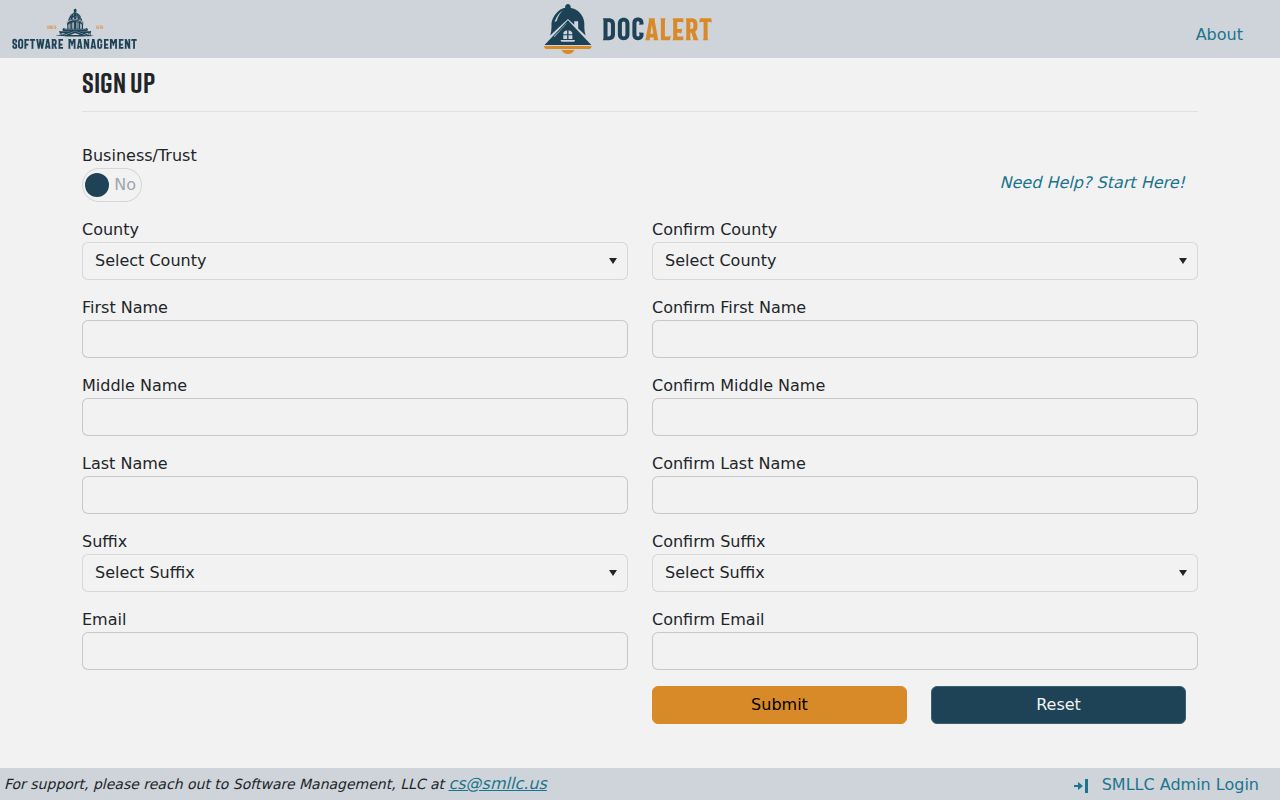
Oldham DOC ALERT is a free notice service. It emails you when a new deed or mortgage is filed under an enrolled person, business, or trust name.
An alert gives early warning. It cannot validate or correct a filing. Check any suspicious notice against the recorded image. Then contact the Clerk and an appropriate legal or law-enforcement professional.
Enrollment takes a legal name. It also accepts the exact name of a business or trust, confirmed by email. Add likely name forms separately when the service permits. A new deed may not match a nickname or a shortened entity label. Save the alert's recording clue and retrieve the underlying document. A mortgage notice may just be expected financing rather than an ownership transfer. A deed notice deserves its own review of parties, legal description, and deed type.
Research Oldham Deed Records Off the Web
The web is only one channel. Public indexes and images are free to view in the Clerk's office. The courthouse holds most documents from 1824 forward. The Kentucky Department for Libraries and Archives inventory lists Oldham deed microfilm covering 1824 through 2011. FamilySearch catalogs deed books from 1824 through 1900 plus an index through 1902. Access can depend on an account or an affiliate location.
The J.C. Barnett Library and Archives at the Oldham County History Center holds local deeds and records dating to the county's formation. An old road, family tract, or community name may not line up with a modern parcel search. It adds context in those cases. That library keeps its own hours and fees. Use its files to pin down people, places, and possible book references. Then return to the Clerk or archival film for the recorded instrument itself.
A pre-1824 chain may leave Oldham County entirely. The county was formed from Henry, Jefferson, and Shelby Counties. Follow the tract, not just the surname. Record each grantor, grantee, deed date, recording date, acreage, legal description, and prior citation as you go. The chain may cross the formation date. Check the parent county in that case rather than forcing an Oldham index to produce a record that predates the county.
For any copy request, give the document type, parties, date range, and book/page or instrument number. State whether you want a plain image or a certified copy. Search access, copy charges, and recording fees are separate. Ask for the current copy price instead of treating the filing schedule as a copy schedule.